
Speech & vision therapy
Your discipline runs on daily repetition. Your schedule is weekly.
Both speech-language pathology and vision therapy depend on frequent, short, correctly graded practice — and both are delivered in a single appointment a week. The six days in between are where the gains are supposed to consolidate, and they are the days you have never been able to see.
The underlying layer
Working underneath the presenting problem
A child who cannot hold a line while reading and a child who cannot hold a sentence while formulating the next one are, more often than the referral letters suggest, running out of the same things: sustained attention, processing speed, timing, working memory and inhibition.
eMazeBrain does not replace articulation work or oculomotor training — it is not built to, and it would be a poor substitute if it tried. It runs underneath them, giving the child short, daily, graded practice on the processing that your session work depends on. You keep the specialist hour for specialist work.
Timing and rhythm
Graded timing tasks with accuracy measured every session, not estimated at the next appointment.
Visual attention and tracking
Sustained attention, discrimination and response inhibition, dosed daily.
Processing speed and working memory
The load-bearing capacities underneath both reading fluency and expressive language.
Why it fits
Short, daily, graded — and actually done
You set the dose
Six minutes five days a week is a real prescription here, not a suggestion. Duration, frequency and intensity are set per child and enforced by the platform.
You see the week
Sessions completed against sessions prescribed, so a plateau can be attributed correctly — to the program, or to the fact that the program did not run.
You adjust without an appointment
Shift the weighting towards timing, drop the intensity for a fortnight, change frequency around a school holiday. All from your own screen, effective immediately.
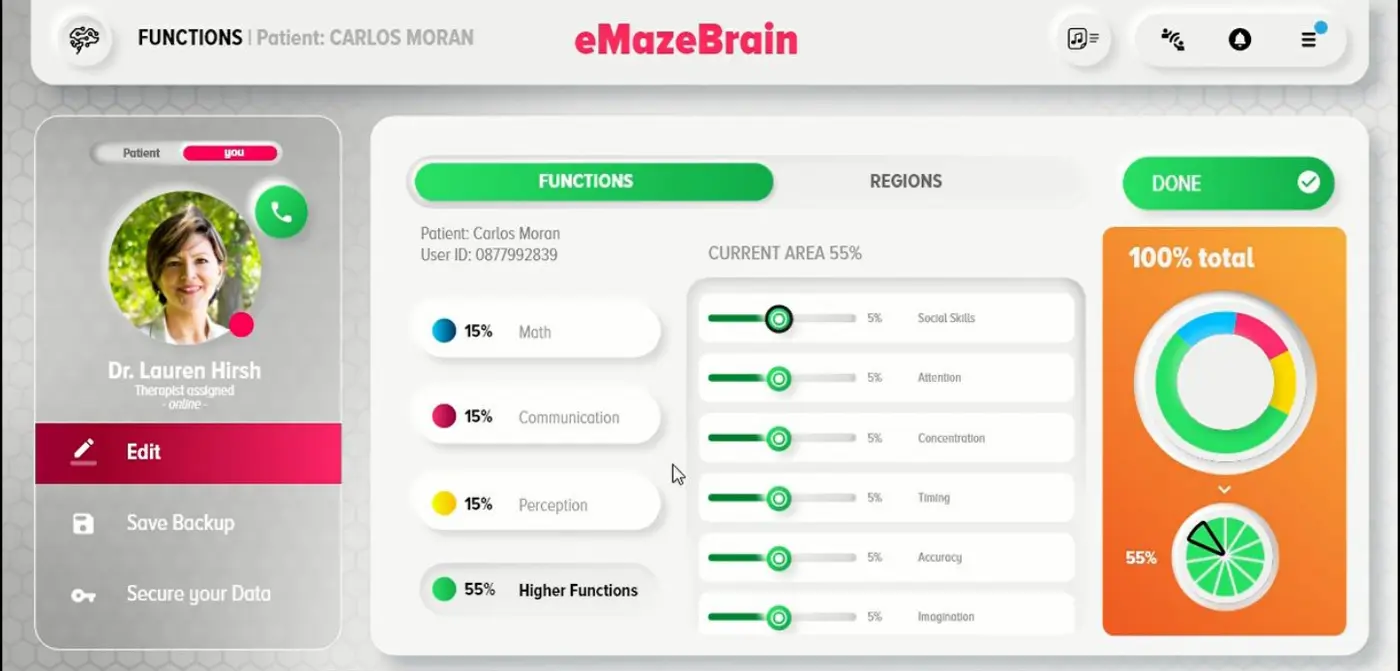
Weighting, at the level you think in
Allocate the program across broad domains, or work at the sub-skill level: social skills, attention, concentration, timing, accuracy and imagination. If your assessment says a child's reading problem is a timing problem, you can put sixty per cent of their week into timing and watch what happens to accuracy.
Because the allocation is explicit and recorded, you can also show a parent or a referring optometrist exactly what the child has been doing — which is a considerably better conversation than “some computer exercises”.
Straight answer
What this will not do
- It does not deliver articulation, phonological or language therapy, and it does not pretend to.
- It does not replace oculomotor, accommodative or binocular vision training performed in your office.
- It does not diagnose anything, and it is not a screening instrument.
- It will not fix a program a child never opens — but it will tell you that is what happened.
What it does is fill the days between your sessions with dosed, measured, graded practice on the processing that everything else rests on — and give you a record of whether it happened. Read what we claim, and what we don't →
See it running against your own caseload.
Twenty minutes, screen-shared, with a clinician who treats these children every week. Bring one patient you're stuck on and we'll build the program live.
Or email drhish@emazelabs.com · WhatsApp +972 50 834 2448